Association Between Chiropractic Use and Opioid Receipt
Association Between Chiropractic Use and Opioid Receipt Among Patients with Spinal Pain: A Systematic Review and Meta-analysis
SOURCE: Pain Medicine 2019 (Sep 27) [Epub]
Kelsey L Corcoran, DC, Lori A Bastian, MD, Craig G Gunderson, MD, Catherine Steffens, Alexandria Brackett, MA, MLIS, Anthony J Lisi, DC
Kelsey L. Corcoran, DC,
Yale Center for Medical Informatics,
300 George St., Suite 501,
New Haven, CT 06511, USA.
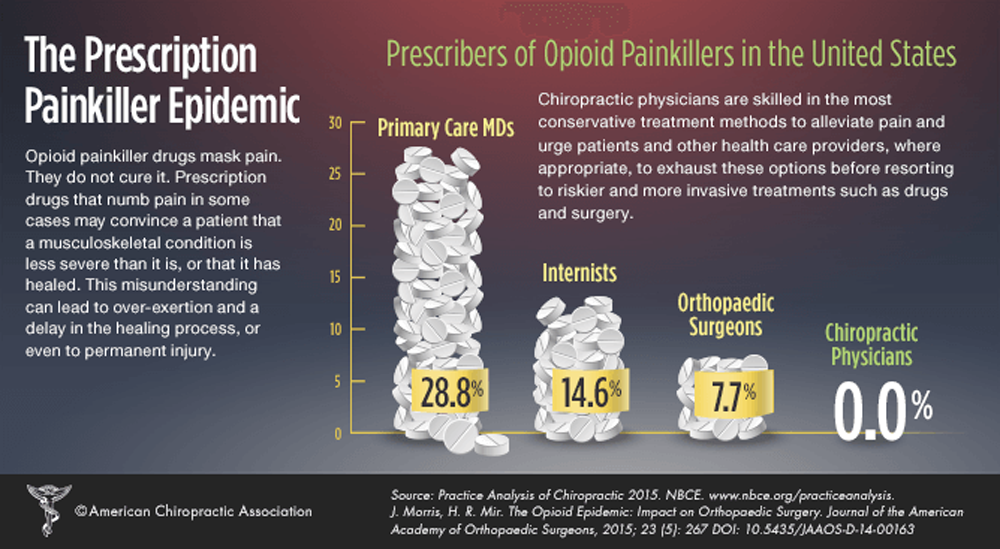
OBJECTIVE: To investigate the current evidence to determine if there is an association between chiropractic use and opioid receipt.
DESIGN: Systematic review and meta-analysis.
METHODS: The protocol for this review was registered on PROSPERO (CRD42018095128). The MEDLINE, PubMed, EMBASE, AMED, CINAHL, and Web of Science databases were searched for relevant articles from database inception through April 18, 2018. Controlled studies, cohort studies, and case-control studies including adults with noncancer pain were eligible for inclusion. Studies reporting opioid receipt for both subjects who used chiropractic care and nonusers were included. Data extraction and risk of bias assessment were completed independently by pairs of reviewers. Meta-analysis was performed and presented as an odds ratio with 95% confidence interval.
RESULTS: In all, 874 articles were identified. After detailed selection, 26 articles were reviewed in full, and six met the inclusion criteria. Five studies focused on back pain and one on neck pain. The prevalence of chiropractic care among patients with spinal pain varied between 11.3% and 51.3%. The proportion of patients receiving an opioid prescription was lower for chiropractic users (range = 12.3–57.6%) than nonusers (range = 31.2–65.9%). In a random-effects analysis, chiropractic users had a 64% lower odds of receiving an opioid prescription than nonusers (odds ratio = 0.36, 95% confidence interval = 0.30–0.43, P < 0.001, I2 = 92.8%).
There are more articles like this @ our: