

Support Chiropractic Research!

Frank M. Painter

About Frank M. Painter

I was introduced to Chiro.Org in early 1996, where my friend Joe Garolis helped me learn HTML, the "mark-up language" for websites. We have been fortunate that journals like JMPT have given us permission to reproduce some early important articles in Full-Text format. Maintaining the Org website has been, and remains, my favorite hobby.

Recent Considerations in Nonsteroidal Anti-inflammatory Drug Gastropathy

By |January 16, 2014|Iatrogenic Injury, NSAIDs|

Recent Considerations in Nonsteroidal Anti-inflammatory Drug Gastropathy

The Chiro.Org Blog


SOURCE:   American Journal of Medicine 1998 (Jul 27);   105 (1B):   31S–38S


Gurkirpal Singh, MD

Department of Medicine, ARAMIS Postmarketing Surveillance Program,
Stanford University of Medicine, Palo Alto, California 94303, USA


Conservative calculations estimate that approximately
107,000 patients are hospitalized annually for nonsteroidal anti-inflammatory drug (NSAID)-related gastrointestinal (GI) complications (internal bleeding) and at least 16,500 NSAID-related deaths occur each year among arthritis patients alone.

The figures for all NSAID users would be overwhelming, yet the scope of this problem is generally under-appreciated (and under-reported!).


In the following year the prestigious New England Journal of Medicine published a similar statement:

“It has been estimated conservatively that 16,500 NSAID-related deaths occur among patients with rheumatoid arthritis or osteoarthritis every year in the United States. This figure is similar to the number of deaths from the acquired immunodeficiency syndrome and is considerably greater than the number of deaths from multiple myeloma, asthma, cervical cancer, or Hodgkin’s disease. If deaths from gastrointestinal toxic effects from NSAIDs were tabulated separately in the National Vital Statistics reports, these effects would constitute the 15th most common cause of death in the United States. Yet these toxic effects remain mainly a “silent epidemic,” with many physicians and most patients unaware of the magnitude of the problem.

Furthermore, these mortality statistics do not include deaths ascribed to the use of over-the-counter NSAIDS.”

Another statement that just happened to catch my eye:

On the basis of these conservative figures and ARAMIS data, the annual number of hospitalizations in the United States for serious gastrointestinal complications is estimated to be at least 103,000. At an estimated cost of $15,000 to $20,000 per hospitalization, the annual direct costs of such complications exceed $2 billion. [14]


Thanks to the American Nutrition Association
for access to this picture!
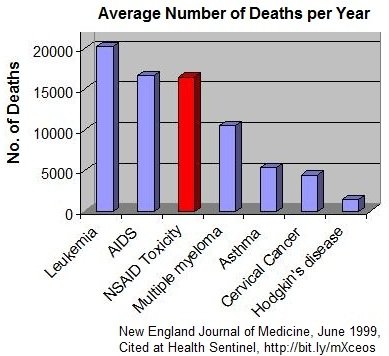
The Arthritis, Rheumatism, and Aging Medical Information System (ARAMIS) Post-Marketing Surveillance Program (PMS) has prospectively followed patient status and outcomes, drug side effects, and the economic impact of illness for >11,000 arthritis patients at 8 participating institutions in the United States and Canada.

Analysis of these data indicates that:

There are more articles like this @ our:

The Iatrogenic Injury Page

(more…)

FDA Asks Docs to Limit Acetaminophen in Prescription Meds

By |January 15, 2014|Iatrogenic Injury|

FDA Asks Docs to Limit Acetaminophen in Prescription Meds

The Chiro.Org Blog


SOURCE:   Medscape Medical News ~ January 15, 2014

By Megan Brooks

Freelance writer for Reuters Health


The US Food and Drug Administration (FDA) is asking healthcare professionals to stop prescribing combination prescription pain relievers that contain more than 325 mg of acetaminophen per tablet, capsule, or other dosage unit, citing the risk for liver damage.

The action targets prescription analgesics that contain both acetaminophen and another ingredient, typically opioids such as codeine, oxycodone, and hydrocodone. Some of these combination products now have as much as 750 mg of acetaminophen per dose.

In a statement, the FDA said, “There are no available data to show that taking more than 325 mg of acetaminophen per dosage unit provides additional benefit that outweighs the added risks for liver injury.”

“Further, limiting the amount of acetaminophen per dosage unit will reduce the risk of severe liver injury from inadvertent acetaminophen overdose, which can lead to liver failure, liver transplant, and death,” they added.

There are more articles like this @ our:

The Iatrogenic Injury Page

(more…)

Musculoskeletal Abnormalities in Chronic Headache

By |January 15, 2014|Chiropractic Care, Forward Head Posture, Headache, Posture|

Musculoskeletal Abnormalities in Chronic Headache: A Controlled Comparison of Headache Diagnostic Groups

The Chiro.Org Blog


SOURCE:   Headache. 1999 (Jan);   39 (1):   21–27


Marcus DA, Scharff L, Mercer S, Turk DC.

Department of Anesthesiology, University of Pittsburgh (Penn) School of Medicine, USA.


The presence of postural, myofascial, and mechanical abnormalities in patients with migraine, tension-type headache, or both headache diagnoses was compared to a headache-free control sample. Twenty-four control subjects were obtained from a convenience sampling and each was matched by age and sex to three patients with headache (one with migraine [with or without aura], one with tension-type headache, and one with diagnoses of both migraine and tension-type headache [combined diagnosis]) who had been previously assessed by a physical therapist at a headache clinic. Physical therapy assessment findings were compared among the four groups.

There are more articles like this @ our:

Headache and Chiropractic Page

(more…)

The Accuracy of Manual Diagnosis

By |January 14, 2014|Manual Diagnosis, Motion Palpation, Palpation, Spinal Joint Pain|

The Accuracy of Manual Diagnosis for Cervical Zygapophysial Joint Pain Syndromes

The Chiro.Org Blog


SOURCE:   Med J Aust. 1988 (Mar 7); 148 (5): 233–236


Jull G,  Bogduk N,  Marsland A.

University of Queensland, St Lucia.


The ability of a manipulative therapist to diagnose symptomatic cervical zygapophysial joint syndromes accurately was evaluated in a series of 20 patients. In 11 patients the presence, or absence, of a symptomatic joint was established by means of radiologically-controlled diagnostic nerve blocks. These patients were assessed by the manipulative therapist, without knowledge of the medical diagnosis. Another nine patients were first seen by the manipulative therapist whose diagnosis was then evaluated by means of diagnostic blocks.

There are more articles like this @ our:

Headache and Chiropractic Page

(more…)

A Diagnosis-based Clinical Decision Rule For Spinal Pain Part 2: Review Of The Literature

By |January 13, 2014|Chiropractic Education, Clinical Decision-making, Diagnosis, Spinal Manipulation|

A Diagnosis-based Clinical Decision Rule For Spinal Pain Part 2: Review Of The Literature

The Chiro.Org Blog


SOURCE:   Chiropractic & Osteopathy 2008 (Aug 11); 16: 7


Donald R Murphy, Eric L Hurwitz, and Craig F Nelson

Rhode Island Spine Center,
Pawtucket, RI 02860, USA


BACKGROUND:   Spinal pain is a common and often disabling problem. The research on various treatments for spinal pain has, for the most part, suggested that while several interventions have demonstrated mild to moderate short-term benefit, no single treatment has a major impact on either pain or disability. There is great need for more accurate diagnosis in patients with spinal pain. In a previous paper, the theoretical model of a diagnosis-based clinical decision rule was presented. The approach is designed to provide the clinician with a strategy for arriving at a specific working diagnosis from which treatment decisions can be made. It is based on three questions of diagnosis. In the current paper, the literature on the reliability and validity of the assessment procedures that are included in the diagnosis-based clinical decision rule is presented.

METHODS:   The databases of Medline, Cinahl, Embase and MANTIS were searched for studies that evaluated the reliability and validity of clinic-based diagnostic procedures for patients with spinal pain that have relevance for questions 2 (which investigates characteristics of the pain source) and 3 (which investigates perpetuating factors of the pain experience). In addition, the reference list of identified papers and authors’ libraries were searched.

RESULTS:   A total of 1769 articles were retrieved, of which 138 were deemed relevant. Fifty-one studies related to reliability and 76 related to validity. One study evaluated both reliability and validity.

CONCLUSION:   Regarding some aspects of the DBCDR, there are a number of studies that allow the clinician to have a reasonable degree of confidence in his or her findings. This is particularly true for centralization signs, neurodynamic signs and psychological perpetuating factors. There are other aspects of the DBCDR in which a lesser degree of confidence is warranted, and in which further research is needed.


From the FULL TEXT Article:

Introduction

Accurate diagnosis or classification of patients with spinal pain has been identified as a research priority [1]. We presented in Part 1 the theoretical model of an approach to diagnosis in patients with spinal pain [2]. This approach incorporated the various factors that have been found, or in some cases theorized, to be of importance in the generation and perpetuation of neck or back pain into an organized scheme upon which a management strategy can be based. The authors termed this approach a diagnosis-based clinical decision rule (DBCDR). The DBCDR is not a clinical prediction rule. It is an attempt to identify aspects of the clinical picture in each patient that are relevant to the perpetuation of pain and disability so that these factors can be addressed with interventions designed to improve them. The purpose of this paper is to review the literature on the methods involved in the DBCDR regarding reliability and validity and to identify those areas in which the literature is currently lacking.

The Three Essential Questions of Diagnosis

The DBCDR is based on what the authors refer to as the 3 essential questions of diagnosis [2]. The answers to these questions supply the clinician with the most important information that is required to develop an individualized diagnosis from which a management strategy can be derived.

There are more articles like this @ our:

Low Back Pain Page and the:

Chronic Neck Pain and Chiropractic Page and the:

Clinical Model for the Diagnosis and Management Page

(more…)

A Theoretical Model For The Development Of A Diagnosis-based Clinical Decision Rule For The Management Of Patients With Spinal Pain

By |January 12, 2014|Chiropractic Care, Clinical Decision-making, Diagnosis, Evidence-based Medicine|

A Theoretical Model For The Development Of A Diagnosis-based Clinical Decision Rule For The Management Of Patients With Spinal Pain

The Chiro.Org Blog


BMC Musculoskelet Disord. 2007 (Aug 3); 8: 75 ~ FULL TEXT


Donald R Murphy and Eric L Hurwitz

Rhode Island Spine Center,
Pawtucket, RI, USA.
rispine@aol.com


BACKGROUND:   Spinal pain is a common problem, and disability related to spinal pain has great consequence in terms of human suffering, medical costs and costs to society. The traditional approach to the non-surgical management of patients with spinal pain, as well as to research in spinal pain, has been such that the type of treatment any given patient receives is determined more by what type of practitioner he or she sees, rather than by diagnosis. Furthermore, determination of treatment depends more on the type of practitioner than by the needs of the patient. Much needed is an approach to clinical management and research that allows clinicians to base treatment decisions on a reliable and valid diagnostic strategy leading to treatment choices that result in demonstrable outcomes in terms of pain relief and functional improvement. The challenges of diagnosis in patients with spinal pain, however, are that spinal pain is often multifactorial, the factors involved are wide ranging, and for most of these factors there exist no definitive objective tests.

DISCUSSION:   The theoretical model of a diagnosis-based clinical decision rule has been developed that may provide clinicians with an approach to non-surgical spine pain patients that allows for specific treatment decisions based on a specific diagnosis. This is not a classification scheme, but a thought process that attempts to identify most important features present in each individual patient. Presented here is a description of the proposed approach, in which reliable and valid assessment procedures are used to arrive at a working diagnosis which considers the disparate factors contributing to spinal pain. Treatment decisions are based on the diagnosis and the outcome of treatment can be measured.

SUMMARY:   In this paper, the theoretical model of a proposed diagnosis-based clinical decision rule is presented. In a subsequent manuscript, the current evidence for the approach will be systematically reviewed, and we will present a research strategy required to fill in the gaps in the current evidence, as well as to investigate the decision rule as a whole.


From the FULL TEXT Article:

Introduction

Chronic spinal pain is an increasingly common problem in Western Society [1]. Spinal disorders exact great costs, in terms of both direct medical costs and indirect costs related to disability and lost productivity [1-3]. A number of researchers have attempted to improve our ability to identify the causes of spinal pain as well as to diagnose and treat patients with this problem. In spite of this, accurate diagnosis, leading to specific, targeted treatments, of patients with spinal pain has been elusive.

It has been repeated over the years that only in 15% of patients with spinal pain can a definitive diagnosis be made [4-6]. However, if one surveys the spine literature, one finds a variety of methods for detecting many of the factors that are believed to be of importance, most of which have known reliability and validity, although there are some that do not. Each of these methods may only help the clinician to identify one particular potential contributing factor in the overall clinical picture of the spine pain patient. However, it may be possible that, by utilizing many of the various diagnostic procedures available to the spine clinician, one can develop a specific working diagnosis that encompasses all of the dimensions for which there may be contributing factors and from which a management strategy may be designed that addresses each of the most important factors in each individual patient.

There are more articles like this @ our:

Low Back Pain Page and the:

Chronic Neck Pain and Chiropractic Page and the:

Clinical Model for the Diagnosis and Management Page

(more…)