

Support Chiropractic Research!

BLOG

Brief Screening Questions For Depression in Chiropractic Patients With Low Back Pain:

By |January 19, 2014|Depression Screening, Low Back Pain, Outcome Assessment|

Brief Screening Questions For Depression in Chiropractic Patients With Low Back Pain: Identification of Potentially Useful Questions and Test of Their Predictive Capacity

The Chiro.Org Blog


Chiropractic & Manual Therapies 2014 (Jan 17); 22: 4


Alice Kongsted, Benedicte Aambakk, Sanne Bossen and Lise Hestbaek

The Nordic Institute of Chiropractic and Clinical Biomechanics,
Campusvej 55,
5230 Odense, M, Denmark


Background   Depression is an important prognostic factor in low back pain (LBP) that appears to be infrequent in chiropractic populations. Identification of depression in few patients would consequently implicate screening of many. It is therefore desirable to have brief screening tools for depression. The objective of this study was to investigate if one or two items from the Major Depression Inventory (MDI) could be a reasonable substitute for the complete scale.

Methods   The MDI was completed by 925 patients consulting a chiropractor due to a new episode of LBP. Outcome measures were LBP intensity and activity limitation at 3-months and 12-months follow-up. Single items on the MDI that correlated strongest and explained most variance in the total score were tested for associations with outcome. Finally, the predictive capacity was compared between the total scale and the items that showed the strongest associations with outcome measures.

Results   In this cohort 9% had signs of depression. The total MDI was significantly associated with outcome but explained very little of the variance in outcome. Four single items performed comparable to the total scale as prognostic factors. Items 1 and 3 explained the most variance in all outcome measures, and their predictive accuracies in terms of area under the curve were at least as high as for the categorised complete scale.

Conclusions   Baseline depression measured by the MDI was associated with a worse outcome in chiropractic patients with LBP. A single item (no. 1 or 3) was a reasonable substitute for the entire scale when screening for depression as a prognostic factor.


From the FULL TEXT Article:

Introduction

Pain and depression often co-exist [1-3] , and although the causal relation between the two is not clear, [4, 5] evidence suggests that pain negatively affects outcome in depression as well as vice versa [6].

Low back pain (LBP) is a highly frequent pain condition with a substantial impact on global health [7] for which the risk of a poor prognosis is increased in the presence of depression [8, 9] . It is a condition for which there is no generally effective treatment, but non-pharmacological treatment addressing psychological symptoms in addition to the physical symptoms has been demonstrated to improve outcome in LBP patients with high scores on psychological questions [10].

There are more articles like this @ our:

Low Back Pain Page and the:

The Biopsychosocial Model Page and the:
The Outcome Assessment Questionnaires Page

(more…)

Our No. 1 Medicare Documentation Error

By |January 18, 2014|Documentation, Medicare|

Our No. 1 Medicare Documentation Error

The Chiro.Org Blog


SOURCE:   Dynamic Chiropractic ~ January 15, 2014

By Susan McClelland


We have all heard that chiropractic documentation is being reviewed by multiple Medicare contractors and that we are failing these reviews miserably. So, where are we going wrong? In this and subsequent articles, let’s address the top reasons we are failing review, starting with the No. 1 reason – our treatment plan documentation.

Medicare regulations require that we create a treatment plan when treating Medicare beneficiaries.

This treatment plan must include three elements or it will fail review:

1) recommended level of care
(duration and frequency of visits);

2) specific treatment goals;

3) objective measures to evaluate treatment effectiveness.

To repeat, the treatment plan must include all three of these elements or it will fail review.

Unfortunately, many doctors of chiropractic are not creating treatment plans at all. For those who do, the plans generally include the recommended level of care (e.g., “Two times a week for two weeks followed by once a week for two weeks. To be re-evaluated for further care at that time”). We generally fall short when it comes to the second and third elements.

There are more articles like this @ our:

Medicare Page

(more…)

Recent Considerations in Nonsteroidal Anti-inflammatory Drug Gastropathy

By |January 16, 2014|Iatrogenic Injury, NSAIDs|

Recent Considerations in Nonsteroidal Anti-inflammatory Drug Gastropathy

The Chiro.Org Blog


SOURCE:   American Journal of Medicine 1998 (Jul 27);   105 (1B):   31S–38S


Gurkirpal Singh, MD

Department of Medicine, ARAMIS Postmarketing Surveillance Program,
Stanford University of Medicine, Palo Alto, California 94303, USA


Conservative calculations estimate that approximately
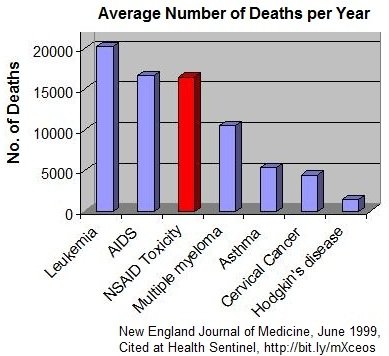
107,000 patients are hospitalized annually for nonsteroidal anti-inflammatory drug (NSAID)-related gastrointestinal (GI) complications (internal bleeding) and at least 16,500 NSAID-related deaths occur each year among arthritis patients alone.

The figures for all NSAID users would be overwhelming, yet the scope of this problem is generally under-appreciated (and under-reported!).


In the following year the prestigious New England Journal of Medicine published a similar statement:

“It has been estimated conservatively that 16,500 NSAID-related deaths occur among patients with rheumatoid arthritis or osteoarthritis every year in the United States. This figure is similar to the number of deaths from the acquired immunodeficiency syndrome and is considerably greater than the number of deaths from multiple myeloma, asthma, cervical cancer, or Hodgkin’s disease. If deaths from gastrointestinal toxic effects from NSAIDs were tabulated separately in the National Vital Statistics reports, these effects would constitute the 15th most common cause of death in the United States. Yet these toxic effects remain mainly a “silent epidemic,” with many physicians and most patients unaware of the magnitude of the problem.

Furthermore, these mortality statistics do not include deaths ascribed to the use of over-the-counter NSAIDS.”

Another statement that just happened to catch my eye:

On the basis of these conservative figures and ARAMIS data, the annual number of hospitalizations in the United States for serious gastrointestinal complications is estimated to be at least 103,000. At an estimated cost of $15,000 to $20,000 per hospitalization, the annual direct costs of such complications exceed $2 billion. [14]


Thanks to the American Nutrition Association
for access to this picture!

The Arthritis, Rheumatism, and Aging Medical Information System (ARAMIS) Post-Marketing Surveillance Program (PMS) has prospectively followed patient status and outcomes, drug side effects, and the economic impact of illness for >11,000 arthritis patients at 8 participating institutions in the United States and Canada.

Analysis of these data indicates that:

There are more articles like this @ our:

The Iatrogenic Injury Page

(more…)

FDA Asks Docs to Limit Acetaminophen in Prescription Meds

By |January 15, 2014|Iatrogenic Injury|

FDA Asks Docs to Limit Acetaminophen in Prescription Meds

The Chiro.Org Blog


SOURCE:   Medscape Medical News ~ January 15, 2014

By Megan Brooks

Freelance writer for Reuters Health


The US Food and Drug Administration (FDA) is asking healthcare professionals to stop prescribing combination prescription pain relievers that contain more than 325 mg of acetaminophen per tablet, capsule, or other dosage unit, citing the risk for liver damage.

The action targets prescription analgesics that contain both acetaminophen and another ingredient, typically opioids such as codeine, oxycodone, and hydrocodone. Some of these combination products now have as much as 750 mg of acetaminophen per dose.

In a statement, the FDA said, “There are no available data to show that taking more than 325 mg of acetaminophen per dosage unit provides additional benefit that outweighs the added risks for liver injury.”

“Further, limiting the amount of acetaminophen per dosage unit will reduce the risk of severe liver injury from inadvertent acetaminophen overdose, which can lead to liver failure, liver transplant, and death,” they added.

There are more articles like this @ our:

The Iatrogenic Injury Page

(more…)

Musculoskeletal Abnormalities in Chronic Headache

By |January 15, 2014|Chiropractic Care, Forward Head Posture, Headache, Posture|

Musculoskeletal Abnormalities in Chronic Headache: A Controlled Comparison of Headache Diagnostic Groups

The Chiro.Org Blog


SOURCE:   Headache. 1999 (Jan);   39 (1):   21–27


Marcus DA, Scharff L, Mercer S, Turk DC.

Department of Anesthesiology, University of Pittsburgh (Penn) School of Medicine, USA.


The presence of postural, myofascial, and mechanical abnormalities in patients with migraine, tension-type headache, or both headache diagnoses was compared to a headache-free control sample. Twenty-four control subjects were obtained from a convenience sampling and each was matched by age and sex to three patients with headache (one with migraine [with or without aura], one with tension-type headache, and one with diagnoses of both migraine and tension-type headache [combined diagnosis]) who had been previously assessed by a physical therapist at a headache clinic. Physical therapy assessment findings were compared among the four groups.

There are more articles like this @ our:

Headache and Chiropractic Page

(more…)

The Accuracy of Manual Diagnosis

By |January 14, 2014|Manual Diagnosis, Motion Palpation, Palpation, Spinal Joint Pain|

The Accuracy of Manual Diagnosis for Cervical Zygapophysial Joint Pain Syndromes

The Chiro.Org Blog


SOURCE:   Med J Aust. 1988 (Mar 7); 148 (5): 233–236


Jull G,  Bogduk N,  Marsland A.

University of Queensland, St Lucia.


The ability of a manipulative therapist to diagnose symptomatic cervical zygapophysial joint syndromes accurately was evaluated in a series of 20 patients. In 11 patients the presence, or absence, of a symptomatic joint was established by means of radiologically-controlled diagnostic nerve blocks. These patients were assessed by the manipulative therapist, without knowledge of the medical diagnosis. Another nine patients were first seen by the manipulative therapist whose diagnosis was then evaluated by means of diagnostic blocks.

There are more articles like this @ our:

Headache and Chiropractic Page

(more…)