

Support Chiropractic Research!

BLOG

Agents of Change: How Do CAM Providers Play a Role

By |June 4, 2018|Alternative Medicine|

Agents of Change: How Do Complementary and Alternative Medicine Providers Play a Role in Health Behavior Change?

The Chiro.Org Blog


SOURCE:   Altern Ther Health Med. 2011 (Jan); 17 (1): 22–30

Pamela A. Williams-Piehota, PhD; Fuschia M. Sirois, PhD; Carla M. Bann, PhD; Karen B. Isenberg, MPH; Edith G. Walsh, PhD

RTI International,
Research Triangle Park,
North Carolina, USA.


BACKGROUND:   Recent investigations indicate that complementary and alternative medicine (CAM) use may be conducive to health behavior change.

OBJECTIVE:   The goal of this study was to investigate how this change occurs.

METHODS:   Using Social Cognitive Theory (SCT) and Self-determination Theory (SDT) as guiding frameworks, we surveyed a convenience sample of 216 CAM consumers abouttheir CAM therapy and iors and conducted focus groups with 36 CAM consumers.

RESULTS:   Consumers reported encouragement from providers and improved energy resulting from treatments as reasons for making health behavior changes. Multivariate analysis showed that increased odds of self-reported dietary change were significantly associated with increasing body awareness as a result of therapy, endorsing the statement that sustained improvement for their health conditions required self-care, using an acupuncturist, and being 44 years or younger. Comparable results were found for exercise change, except using an acupuncturist was a significant negative predictor and age was not significant. Focus group findings echoed these themes.

There are more articles like this @ our:
Alternative Medicine Articles Section

(more…)

Association Between Centralization and Directional Preference

By |June 3, 2018|Chronic Neck Pain, McKenzie|

Association Between Centralization and Directional Preference and Functional and Pain Outcomes in Patients With Neck Pain

The Chiro.Org Blog


SOURCE:   J Orthop Sports Phys Ther. 2014 (Feb); 44 (2): 68–75

Susan L. Edmond, PT, DSc, OCS, Guillermo Cutrone, PT, DSc, OCS, Cert MDT, FAAOMPT, Mark Werneke, PT, MS, Dip MDT et. al.

Rutgers,
The State University of New Jersey,
Newark, NJ.


STUDY DESIGN:   Retrospective cohort.

OBJECTIVES:   In subjects with neck pain, the present study aimed (1) to describe the prevalence of centralization (CEN), noncentralization (non-CEN), directional preference (DP), and no directional preference (no DP); (2) to determine if age, sex, fear-avoidance beliefs about physical activity, number of comorbid conditions, or symptom duration varies among subjects who demonstrate CEN versus non-CEN and DP versus no DP; and (3) to determine if CEN and/or DP are associated with changes in function and pain.

BACKGROUND:   CEN and DP are prevalent among patients with low back pain and should be considered when determining treatment strategies and predicting outcomes; however, these findings are not well investigated in patients with neck pain.

METHODS:   Three hundred four subjects contributed data. CEN and DP prevalence were calculated, as was the association between CEN and DP, and age, sex, number of comorbid conditions, fear-avoidance beliefs, and symptom duration. Multivariate models assessed whether CEN and DP predicted change in function and pain.

RESULTS:   CEN and DP prevalence were 0.4 and 0.7, respectively. Younger subjects and those with fewer comorbid conditions were more likely to centralize; however, subjects who demonstrated DP were more likely to have acute symptoms. Subjects who centralized experienced, on average, a 3.6-point (95% confidence interval: -0.3, 7.4) improvement in function scores, whereas subjects with a DP averaged a 5.4-point (95% confidence interval: 0.8, 10.0) improvement. Neither CEN nor DP was associated with pain outcomes.

There are more articles like this @ our:
Chronic Neck Pain and Chiropractic Page

(more…)

Centralization and Directional Preference

By |May 31, 2018|Centralization, Directional Preference|

Centralization and Directional Preference: A Systematic Review

The Chiro.Org Blog


SOURCE:   Man Ther. 2012 (Dec); 17 (6): 497–506

Stephen May, Alessandro Aina

Faculty of Health and Wellbeing,
Collegiate Cresent Campus,
Sheffield Hallam University,
Sheffield S10 2BP, UK.


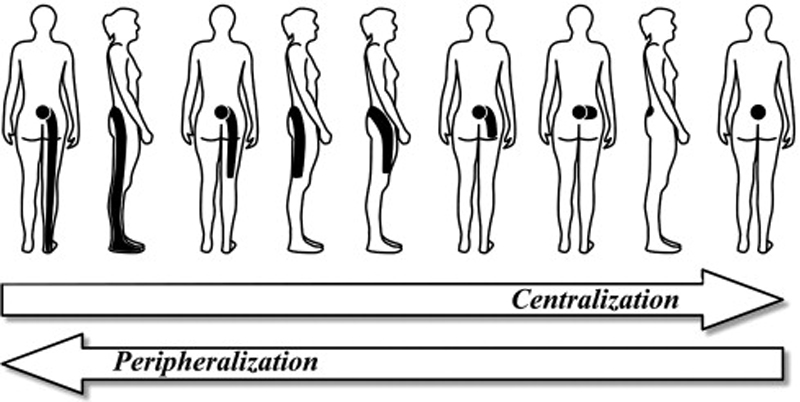
Centralization is a symptom response to repeated movements that can be used to classify patients into sub-groups, determine appropriate management strategies, and prognosis. The aim of this study was to systematically review the literature relating to centralization and directional preference, and specifically report on prevalence, prognostic validity, reliability, loading strategies, and diagnostic implications. Search was conducted to June 2011; multiple study designs were considered. 62 studies were included in the review; 54 related to centralization and 8 to directional preference. The prevalence of centralization was 44.4% (range 11%-89%) in 4,745 patients with back and neck pain in 29 studies; it was more prevalent in acute (74%) than sub-acute or chronic (42%) symptoms.

The prevalence of directional preference was 70% (range 60%-78%) in 2,368 patients with back or neck pain in 5 studies. Twenty-one of 23 studies supported the prognostic validity of centralization, including 3 high quality studies and 4 of moderate quality; whereas 2 moderate quality studies showed evidence that did not support the prognostic validity of centralization. Data on the prognostic validity of directional preference was limited to one study. Centralization and directional preference appear to be useful treatment effect modifiers in 7 out of 8 studies. Levels of reliability were very variable (kappa 0.15-0.9) in 5 studies. Findings of centralization or directional preference at baseline would appear to be useful indicators of management strategies and prognosis, and therefore warrant further investigation.


From the FULL TEXT Article:

Introduction

There are more articles like this @ our:

Low Back Pain and Chiropractic Page

(more…)

The Comparative Prognostic Value of Directional Preference

By |May 30, 2018|Centralization, Directional Preference|

The Comparative Prognostic Value of Directional Preference and Centralization: A Useful Yool for Front-line Clinicians?

The Chiro.Org Blog


SOURCE:   J Man Manip Ther. 2008; 16 (4): 248–254

Audrey Long, BSc, PT, Stephen May, MSc, and Tak Fung, PhD

Senior Statistical Consultant,
University of Calgary,
Calgary AB, Canada.


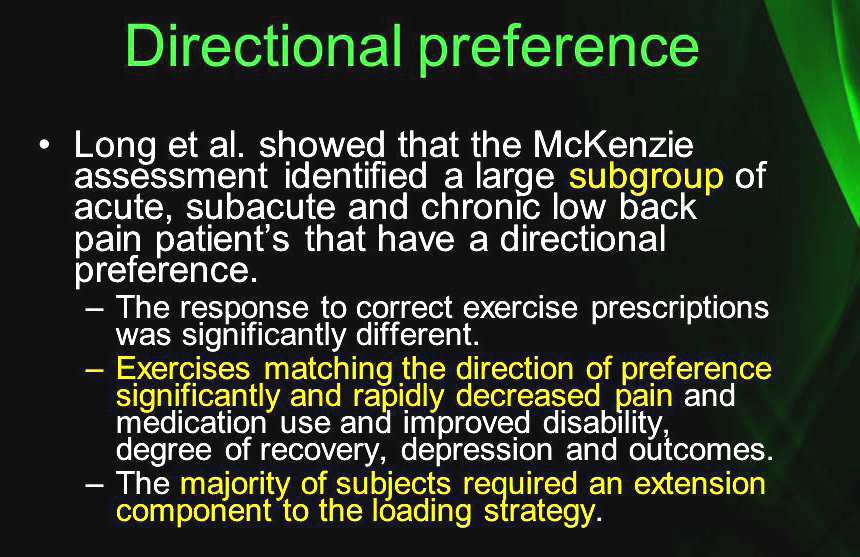
A large number of prognostic factors have been associated with recovery from an episode of back pain, and much emphasis has been placed on psychosocial prognostic factors. The large number of prognostic factors and the lack of comparative analysis of different factors make use of these difficult in clinical practice. The aim of this study was to evaluate the comparative usefulness of a range of factors to predict outcome using data from a randomized controlled trial (RCT) in which 312 patients with sub-acute to chronic back pain received a mechanical evaluation and were sub-grouped based on the presence or absence of directional preference (DP). Patients were then randomized to treatment that was matched or unmatched to that DP.

Patients with a minimal reduction of 30% in Roland-Morris Disability Questionnaire (RMDQ) score were defined as the good outcome group. Seventeen baseline variables were entered into a step-wise logistic regression analysis for the ability to predict a good outcome. Of the patients, 84 met the good outcome criteria and had a mean RMDQ decrease of 58.2% (9.8 points) in 4 visits. Leg pain, work status, depression, pain location, chronicity, and treatment assignment were significant predictors of outcome in univariate analysis. Only leg bothersomeness rating and treatment assignment survived multivariate analysis. Subjects with DP/centralization who received matched treatment had a 7.8 times greater likelihood of a good outcome. Matching patients to their DP is a stronger predictor of outcome than a range of other biopsychosocial factors.

There are more articles like this @ our:

Low Back Pain and Chiropractic Page

(more…)

Spine-area Pain in Military Personnel

By |May 29, 2018|Veterans|

Spine-area Pain in Military Personnel: A Review of Epidemiology, Etiology, Diagnosis, and Treatment

The Chiro.Org Blog


SOURCE:   Spine J. 2012 (Sep); 12 (9): 833-842

Steven P. Cohen, MD, Rollin M. Gallagher, MD, MPH, Shelton A. Davis, MD, Scott R. Griffith, MD, Eugene J. Carragee, MD

Pain Management Division, Department of Anesthesiology & Critical Care Medicine,
Johns Hopkins School of Medicine,
Baltimore, MD 21205, USA.


BACKGROUND CONTEXT:   non-battle illnesses and injuries are the major causes of unit attrition in modern warfare. Spine-area pain is a common disabling injury in service members associated with a very low return-to-duty (RTD) rate.

PURPOSE:   To provide an overview of the current understanding of epidemiology, possible causes, and relative prognosis of spine-area pain syndromes in military personnel, including a discussion of various treatment options available in theaters of operation.

STUDY DESIGN:   Literature review.

METHODS:   Search focusing on epidemiology, etiology and associative factors, and treatment of spinal pain using electronic databases, textbooks, bibliographic references, and personal accounts.

RESULTS:   Spine-area pain is the most common injury or complaint “in garrison” and appears to increase during training and combat deployments. Approximately three-quarters involve low back pain, followed by cervical and midback pain syndromes. Some predictive factors associated with spine-area pain are similar to those observed in civilian cohorts, such as psychosocial distress, heavy physical activity, and more sedentary lifestyle. Risk factors specific to military personnel include concomitant psychological trauma, g-force exposure in pilots and airmen, extreme shock and vibration exposure, heavy combat load requirements, and falls incurred during airborne, air assault, and urban dismounted ground operations. Effective forward-deployed treatment has been difficult to implement, but newer strategies may improve RTD rates.

There are more articles like this @ our:

Chiropractic Care For Veterans Page

(more…)