

Support Chiropractic Research!

Frank M. Painter

About Frank M. Painter

I was introduced to Chiro.Org in early 1996, where my friend Joe Garolis helped me learn HTML, the "mark-up language" for websites. We have been fortunate that journals like JMPT have given us permission to reproduce some early important articles in Full-Text format. Maintaining the Org website has been, and remains, my favorite hobby.

Epidemiology: Spinal Manipulation Utilization

By |May 22, 2018|Chiropractic Care|

Epidemiology: Spinal Manipulation Utilization

The Chiro.Org Blog


SOURCE:   J Electromyogr Kinesiol. 2012 (Oct); 22 (5): 648–654


Eric L. Hurwitz

Department of Public Health Sciences,
John A. Burns School of Medicine,
University of Hawaii,
M?noa, Honolulu, HI 96822, USA.


The objectives of this article are to

        (1)   describe spinal manipulation use by time, place, and person, and

        (2)   identify predictors of the use of spinal manipulation.

We conducted a systematic review of the English-language literature published from January 1, 1980 through June 30, 2011. Of 822 citations identified, 213 were deemed potentially relevant; 75 were included after further consideration. Twenty-one additional articles were identified from reference lists. The literature is heavily weighted toward North America, Europe, and Australia and thus largely precludes inferences about spinal manipulation use in other parts of the world. In the regions covered by the literature, chiropractors, osteopaths, and physical therapists are most likely to deliver spinal manipulation, often in conjunction with other conservative therapies.

Back and neck pain are the most frequent indications for receiving spinal manipulation; non-musculoskeletal conditions comprise a very small percentage of indications. Although spinal manipulation is more commonly used in adults than children, evidence suggests that spinal manipulation may be more likely used for non-musculoskeletal ailments in children than in adults. Patient satisfaction with spinal manipulation is very high.


From the Full-Text Article:

Introduction

Although spinal manipulation has been practiced for thousands of years in several cultures spanning the globe, it is most commonly associated with chiropractic and osteopathy, which originated in the late 1800s in the United States (Pettman, 2007). The purpose of this article is to review the literature on the use of spinal manipulation. Specifically, our objectives are twofold: (1) To describe spinal manipulation use by time (temporal trends), place (geographic distribution), and person (practitioner and patient), and (2) to identify predictors of the use of spinal manipulation.

There are more articles like this @ our:
About Chiropractic Page

(more…)

Chiropractic Treatment Including Instrument-assisted Manipulation

By |May 21, 2018|Vertigo|

Chiropractic Treatment Including Instrument-assisted Manipulation for Non-specific Dizziness and Neck Pain in Community-dwelling Older People: A Feasibility Randomised Sham-controlled Trial

The Chiro.Org Blog


SOURCE:   Chiropractic & Manual Therapies 2018 (May 10); 26: 14


Julie C. Kendall, Simon D. French, Jan Hartvigsen, and Michael F. Azari

School of Health and Biomedical Sciences,
RMIT University,
PO Box 71 Bundoora,
Melbourne, VIC 3083 Australia.


BACKGROUND:   Dizziness in older people is a risk factor for falls. Neck pain is associated with dizziness and responds favourably to neck manipulation. However, it is unknown if chiropractic intervention including instrument-assisted manipulation of the neck in older people with neck pain can also improve dizziness.

METHODS:   This parallel two-arm pilot trial was conducted in Melbourne, Australia over nine months (October 2015 to June 2016). Participants aged 65–85 years, with self-reported chronic neck pain and dizziness, were recruited from the general public through advertisements in local community newspapers and via Facebook. Participants were randomised using a permuted block method to one of two groups: 1) Activator II™-instrument-assisted cervical and thoracic spine manipulation plus a combination of: light massage; mobilisation; range of motion exercises; and home advice about the application of heat, or 2) Sham-Activator II™-instrument-assisted manipulation (set to zero impulse) plus gentle touch of cervical and thoracic spinal regions. Participants were blinded to group allocation. The interventions were delivered weekly for four weeks. Assessments were conducted one week pre- and post-intervention. Clinical outcomes were assessed blindly and included: dizziness (dizziness handicap inventory [DHI]); neck pain (neck disability index [NDI]); self-reported concerns of falling; mood; physical function; and treatment satisfaction. Feasibility outcomes included recruitment rates, compliance with intervention and outcome assessment, study location, success of blinding, costs and harms.

RESULTS:   Out of 162 enquiries, 24 participants were screened as eligible and randomised to either the chiropractic (n = 13) or sham (n = 11) intervention group. Compliance was satisfactory with only two participants lost to follow up; thus, post-intervention data for 12 chiropractic intervention and 10 sham intervention participants were analysed. Blinding was similar between groups. Mild harms of increased spinal pain or headaches were reported by 6 participants. Costs amounted to AUD$2635 per participant. The data showed a trend favouring the chiropractic group in terms of clinically-significant improvements in both NDI and DHI scores. Sample sizes of n = 150 or n = 222 for dizziness or neck pain disability as the primary outcome measure, respectively, would be needed for a fully powered trial.

There are more articles like this @ our:
Vertigo, Balance and Chiropractic Page

(more…)

Manipulation and Mobilization for Treating Chronic Low Back Pain

By |May 17, 2018|Low Back Pain|

Manipulation and Mobilization for Treating Chronic Low Back Pain: A Systematic Review and Meta-analysis

The Chiro.Org Blog


SOURCE:   Spine J. 2018 (May); 18 (5): 866–879


Ian D. Coulter, PhD, Cindy Crawford, BA, Eric L. Hurwitz, DC, PhD, Howard Vernon, DC, PhD, Raheleh Khorsan, PhD, Marika Suttorp Booth, MS, Patricia M. Herman, ND, PhD

RAND Corporation,
1776 Main St,
Santa Monica, CA 90407-2138, USA


BACKGROUND CONTEXT:   Mobilization and manipulation therapies are widely used to benefit patients with chronic low back pain. However, questions remain about their efficacy, dosing, safety, and how these approaches compare with other therapies.

PURPOSE:   The present study aims to determine the efficacy, effectiveness, and safety of various mobilization and manipulation therapies for treatment of chronic low back pain.

STUDY DESIGN/SETTING:   This is a systematic literature review and meta-analysis.

OUTCOME MEASURES:   The present study measures self-reported pain, function, health-related quality of life, and adverse events.

METHODS:   We identified studies by searching multiple electronic databases from January 2000 to March 2017, examining reference lists, and communicating with experts. We selected randomized controlled trials comparing manipulation or mobilization therapies with sham, no treatment, other active therapies, and multimodal therapeutic approaches. We assessed risk of bias using Scottish Intercollegiate Guidelines Network criteria. Where possible, we pooled data using random-effects meta-analysis. Grading of Recommendations, Assessment, Development, and Evaluation (GRADE) was applied to determine the confidence in effect estimates. This project is funded by the National Center for Complementary and Integrative Health under Award Number U19AT007912.

RESULTS:   Fifty-one trials were included in the systematic review. Nine trials (1,176 patients) provided sufficient data and were judged similar enough to be pooled for meta-analysis. The standardized mean difference for a reduction of pain was SMD=–0.28, 95% confidence interval (CI) –0.47 to –0.09, p=.004; I2=57% after treatment; within seven trials (923 patients), the reduction in disability was SMD=–0.33, 95% CI –0.63 to –0.03, p=.03; I2=78% for manipulation or mobilization compared with other active therapies. Subgroup analyses showed that manipulation significantly reduced pain and disability, compared with other active comparators including exercise and physical therapy (SMD=–0.43, 95% CI –0.86 to 0.00; p=.05, I2=79%; SMD=–0.86, 95% CI –1.27 to –0.45; p<.0001, I2=46%). Mobilization interventions, compared with other active comparators including exercise regimens, significantly reduced pain (SMD=–0.20, 95% CI –0.35 to –0.04; p=.01; I2=0%) but not disability (SMD=–0.10, 95% CI –0.28 to 0.07; p=.25; I2=21%). Studies comparing manipulation or mobilization with sham or no treatment were too few or too heterogeneous to allow for pooling as were studies examining relationships between dose and outcomes. Few studies assessed health-related quality of life. Twenty-six of 51 trials were multimodal studies and narratively described.

There are more articles like this @ our:
Low Back Pain and Chiropractic Page

(more…)

Directional Preference and Functional Outcomes Among Subjects Classified at High Psychosocial Risk Using STarT

By |May 14, 2018|McKenzie|

Directional Preference and Functional Outcomes Among Subjects Classified at High Psychosocial Risk Using STarT

The Chiro.Org Blog


SOURCE:   Physiother Res Int. 2018 (Mar 14) [Epub]


Mark W. Werneke, Susan Edmond, Michelle Young, David Grigsby, Brian McClenahan, Troy McGill

Doctoral Programs in Physical Therapy,
Rutgers, The State University of New Jersey,
Newark, NJ, USA


BACKGROUND AND PURPOSE:   Physiotherapy has an important role in managing patients with non-specific low back pain who experience elevated psychosocial distress or risk for chronic disability. In terms of evidence-based physiotherapy practice, cognitive-behavioural approaches for patients at high psychosocial risk are the recommended management to improve patient treatment outcomes. Evidence also suggests that directional preference (DP) is an important treatment effect modifier for prescribing specific exercises for patients to improve outcomes. Little is known about the influence of treatment techniques based on DP on outcomes for patients classified as high psychosocial risk using the Subgroups for Targeted Treatment (STarT Back Screening Tool). This study aimed to examine the association between functional status (FS) at rehabilitation discharge for patients experiencing low back pain classified at high STarT psychosocial risk and whose symptoms showed a DP versus No-DP.

METHODS:   High STarT risk patients (n = 138) completed intake surveys, that is, the lumbar FS of Focus On Therapeutic Outcomes, Inc., and STarT, and were evaluated for DP by physiotherapists credentialed in McKenzie methods. The FS measure of Focus On Therapeutic Outcomes, Inc., was repeated at discharge. DP and No-DP prevalence rates were calculated. Associations between first-visit DP and No-DP and change in FS were assessed using univariate and multivariate regression models controlling for 11 risk-adjusted variables.

RESULTS:   One hundred nine patients classified as high STarT risk had complete intake and discharge FS and DP data. Prevalence rate for DP was 65.1%. A significant and clinically important difference (7.98 FS points; p = .03) in change in function at discharge between DP and No-DP was observed after controlling for all confounding variables in the final model.

(more…)

The Role of Spinal Manipulation in Addressing Disordered Sensorimotor Integration

By |May 4, 2018|Subluxation|

The Role of Spinal Manipulation in Addressing Disordered Sensorimotor Integration and Altered Motor Control

The Chiro.Org Blog


SOURCE:   J Electromyogr Kinesiol. 2012 (Oct); 22 (5): 768–776


Heidi Haavik, Bernadette Murphy

New Zealand College of Chiropractic,
Auckland, New Zealand.


This review provides an overview of some of the growing body of research on the effects of spinal manipulation on sensory processing, motor output, functional performance and sensorimotor integration. It describes a body of work using somatosensory evoked potentials (SEPs), transcranial magnetic nerve stimulation, and electromyographic techniques to demonstrate neurophysiological changes following spinal manipulation. This work contributes to the understanding of how an initial episode(s) of back or neck pain may lead to ongoing changes in input from the spine which over time lead to altered sensorimotor integration of input from the spine and limbs.


From the Full-Text Article:

Introduction

Over the past 15 years our research group has conducted a variety of human experiments that have added to our understanding of the central neural plastic effects of manual spinal manipulation (Haavik and Murphy, 2011; Haavik-Taylor and Murphy, 2007a,b, 2008, 2010c; Haavik-Taylor et al., 2010; Marshall and Murphy, 2006). Spinal manipulation is used therapeutically by a number of health professionals, all of whom have different terminology for the ‘‘entity’’ that they manipulate. This ‘‘entity’’ which generally describes areas of muscle tightness, tenderness and restricted movement may be called a ‘‘vertebral (spinal) lesion’’ by physical medicine specialists or physiotherapists, ‘‘somatic dysfunction’’ or ‘‘spinal lesion’’ by osteopaths, and ‘‘vertebral subluxation’’ or ‘‘spinal fixation’’ by chiropractors (Leach, 1986). For the purposes of this article, the ‘‘manipulable lesion’’ will be referred to as an area of spinal dysfunction or joint dysfunction. Joint dysfunction as discussed in the literature ranges from experimentally induced joint effusion (Shakespeare et al., 1985), pathological joint disease such as osteoarthritis (O’Connor et al., 1993) as well as the more subtle functional alterations that are commonly treated by manipulative therapists (Suter et al., 1999, 2000).

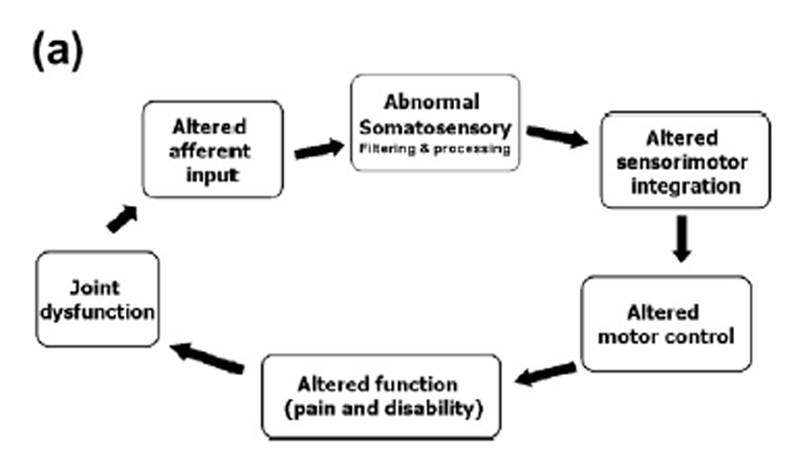
Figure 1

Based on our research findings we have proposed that areas of spinal dysfunction, represent a state of altered afferent input which may be responsible for ongoing central plastic changes (Haavik-Taylor et al., 2010; Haavik-Taylor and Murphy, 2007c). Furthermorewe have proposed a potential mechanism which could explain how high-velocity, low-amplitude spinal manipulation, also known as spinal adjustments, improve function and reduce symptoms. We have proposed that altered afferent feedback from an area of spinal dysfunction alters the afferent ‘‘milieu’’ into which subsequent afferent feedback from the spine and limbs is received and processed, thus leading to altered sensorimotor integration (SMI) of the afferent input, which is then normalized by highvelocity, low-amplitude manipulation (Haavik-Taylor et al., 2010; Haavik-Taylor and Murphy, 2007c). For a pictorial depiction of this hypothesis, see Figure 1.

There are more articles like this @ our:
The Neurologic Component of the Subluxation Complex

(more…)

Challenges of the Past, Challenges of the Present

By |May 3, 2018|Chiropractic Education|

Challenges of the Past, Challenges of the Present

The Chiro.Org Blog


SOURCE:   J Chiropractic Humanities 2015 (Nov 18); 22 (1): 30–46


Scott Haldeman, DC, MD, PhD

Adjunct Professor,
Department of Epidemiology,
School of Public Health,
University of California,
Los Angeles, CA.


The McAndrews Leadership Lecture was developed by the American Chiropractic Association to honor the legacy of Jerome F. McAndrews, DC, and George P. McAndrews, JD, and their contributions to the chiropractic profession. This article is a transcription of the presentation made by Dr Scott Haldeman on February 28, 2015, in Washington, DC, at the National Chiropractic Leadership Conference.

KEYWORDS:   Chiropractic; History; Humanities; Philosophy


The Full-Text Lecture:

The McAndrews Leadership Lecture by Scott Haldeman, DC, MD, PhD

Thank you, Christine (Goertz, DC, PhD), for your kind words. I also want to thank George (P. McAndrews, JD) for his wonderful presentation and for the discussion. We all appreciate what George has done. In addition, I want to thank Lou (Sportelli, DC), one of my oldest and best friends. The profession would not be where it is if it were not for you.

This was a difficult talk to prepare. I received a request from Tony (W. Hamm, DC) to do the inaugural McAndrews Leadership Lecture. I told him that normally when I lecture, I present statistics and graphs and lots of different numbers and figures. For this lecture, I thought something different would be in order. So I am going to try something new, although I am not sure it is going to work. I am going to make it very personal, primarily because Jerry and George played a very important part in my professional life and growth. In this presentation, I want to explain how the world has evolved over the last 50 years and include how the McAndrews brothers played a part in this evolution.

I want start by having you imagine an 18-year-old kid from South Africa who arrives in Davenport, IA, on New Year’s Eve in a snowstorm. His father was a chiropractor, and his grandmother was the very first chiropractor ever to practice in Canada. And, unlike George, this young man received his first adjustment at the age of 2 days old. (I cannot beat them all.) Growing up in a chiropractic household, adjustments were the first treatment consideration for any illness. However, we primarily grew up with an understanding that the body has an innate ability to heal itself provided it is taken care of. Adjustments were not the cure for everything, but adjustments were given when needed.

I was an 18-year-old kid who arrives in a snowstorm in Davenport, but my ride does not show up. I ended up sitting at the edge of the airport, in the snowstorm, waiting until they closed and switched the lights off. Luckily, a Palmer student who was a taxi driver came by on his last rounds, picked me up, and dropped me off at a frat house for a New Year’s Eve party.

There are more articles like this @ our:

About Chiropractic Page

(more…)