

Support Chiropractic Research!

BLOG

The Alamo, Part 2: The Texas Medical AssociationContinues to Suppress Chiropractic

By |May 19, 2015|Announcement|

The Alamo, Part 2: The Texas Medical Association
Continues to Suppress Chiropractic

The Chiro.Org Blog


SOURCE:  Texas Medicine ~ May 2015


By Kara Nuzback


Edited from their article:

The Affordable Care Act promotes collaboration and team treatment of patients. The Texas Medical Association agrees collaborative care is crucial, but the association wants to ensure physicians remain the head of the team. With the Texas Legislature in full swing, physicians face several bills that would challenge that leadership and expand the scope of practice for nurses, chiropractors, and other health professionals without a license to practice medicine.

Fort Worth pediatrician Gary Floyd, MD, says he started testifying before the legislature in defense of patients in the 1990s. Every session, a similar onslaught of bills arises from nonphysician practitioners aiming to expand their scope of practice.

“A lot of them are reaching beyond what they’ve been educated and trained to do, and beyond what their skill sets allow them to do,” he said. “That puts patients in danger.”

These medical professionals also put their own licenses at risk, he says. “When you over-reach, you get in trouble,” he added.

Dr. Floyd does not downplay the need for nurses and other midlevel professionals, but he emphasizes the importance of physician supervision. “They are part of a physician-led health care team,” he said. “We strongly believe that is the best model for delivering care.”


That roughly translates into: They can only do what WE permit, and no more!


This section is quite revealing:

Chiropractors:

TMA has gone up to bat against the Texas Board of Chiropractic Examiners (TBCE) in the past to fight rule changes that would expand chiropractors’ scope.

In 2006, TMA took TBCE to court to invalidate the board’s adoption of rules that would have allowed chiropractors to make diagnoses and perform needle electromyography (EMG) and spinal manipulation under anesthesia (MUA). In 2012, an appellate court invalidated TBCE’s rules allowing EMG and MUA, but it said it had no jurisdiction to consider the diagnosis rule. TMA appealed the diagnosis decision to the Texas Supreme Court the same year, but in 2013, the high court decided not to hear the case. The issue of chiropractors diagnosing medical conditions is not yet resolved.

(more…)

Navigating HIPAA in the Electronic Age:What DCs Must Know

By |April 29, 2015|HIPAA, Practice Management|

Navigating HIPAA in the Electronic Age:
What DCs Must Know

The Chiro.Org Blog


SOURCE:   ACA News ~ March 2015


By Gina Shaw


It has been nearly 20 years since the Health Insurance Portability and Accountability Act of 1996 (HIPAA) was passed and more than five years since its privacy protections for health care consumers were significantly strengthened by the Health Information Technology for Economic and Clinical Health (HITECH) Act of 2009, as more healthcare transactions became electronic.

But even so, many clinicians — especially those in smaller, often non-hospital-affiliated practices such as chiropractic — may not be up to speed on what they need to do to protect their patients’ privacy in the electronic age and comply with laws like HIPAA and HITECH, says Steven Baker, DC, DABFP, DABCO, a councilor with the Council on Chiropractic Education.

“Pretty much every office has a HIPAA form that they have their patients sign, saying here’s what we can do with your information,” he says. “But often they have just picked it up from a practice management group, and they may not really know what’s on that form or what it obligates them to do.”

So here are a few things every doctor of chiropractic (DC) and chiropractic office staffer should know about electronic privacy:


1.   Do the laws apply to you?

Most health care practitioners are considered “covered entities” under HIPAA and HITECH — but not necessarily all. Healthcare providers are considered covered entities if they electronically transmit “PHI” — protected health information. You can collect individually identifiable health information without transmitting it electronically, although that’s becoming rare these days.

Learn more about HIPPA @ our:

HIPAA Compliance Page

(more…)

Tylenol Is Ineffective For Treating Low Back Pain or Disability.

By |April 18, 2015|NSAIDs|

The Limits of Tylenol for Pain Relief

The Chiro.Org Blog


SOURCE:   New York Times ~ April 1, 2015

By Nicholas Bakalar


Acetaminophen, also known as paracetamol (Tylenol) is widely recommended for the relief of back pain and the pain of knee and hip arthritis. But a systematic review of randomized trials has found that it works no better than a placebo.

Australian researchers reviewed three randomized trials that compared acetaminophen with a placebo for the relief of spinal pain, and 10 trials that compared their use for easing the pain of osteoarthritis. All together, the analysis included 5,366 patients. Acetaminophen was given orally in doses between 3,000 and 4,000 milligrams a day, except for one study in which a dose of 1,000 milligrams was administered intravenously.

The review, published online in BMJ (British Medical Journal), found high quality evidence that Tylenol is ineffective in treating low back pain or disability. It also found evidence that the drug quadruples the risk of an abnormal liver function test, but the clinical significance of that finding is unclear.

[Editor’s Note:   Actually, reports as far back as 2001 suggest that 36 percent of acute liver failures are linked to acetaminophen use. Would you like to guess what it costs for a liver transplant, plus the added costs of anti-rejection drugs for a lifetime?   Another review in the American Journal of Medicine estimates that 107,000 patients are hospitalized annually for nonsteroidal anti-inflammatory drug (NSAID)-related gastrointestinal (GI) complications (internal bleeding) and at least 16,500 NSAID-related deaths occur each year among arthritis patients alone.   The figures for all NSAID users would be overwhelming, yet the scope of this problem is generally under-appreciated, and under-reported.]

There are more articles like this @ our:

Iatrogenic Injury Page

(more…)

Real-Time Visualization of Joint Cavitation

By |April 16, 2015|Chiropractic Care|

Real-Time Visualization of Joint Cavitation

The Chiro.Org Blog


SOURCE:   PLoS One. 2015 (Apr 15); 10 (4): e0119470


Gregory N. Kawchuk, Jerome Fryer, Jacob L. Jaremko,
Hongbo Zeng, Lindsay Rowe, Richard Thompson

Department of Physical Therapy,
Faculty of Rehabilitation Medicine,
University of Alberta,
Edmonton, Alberta, Canada


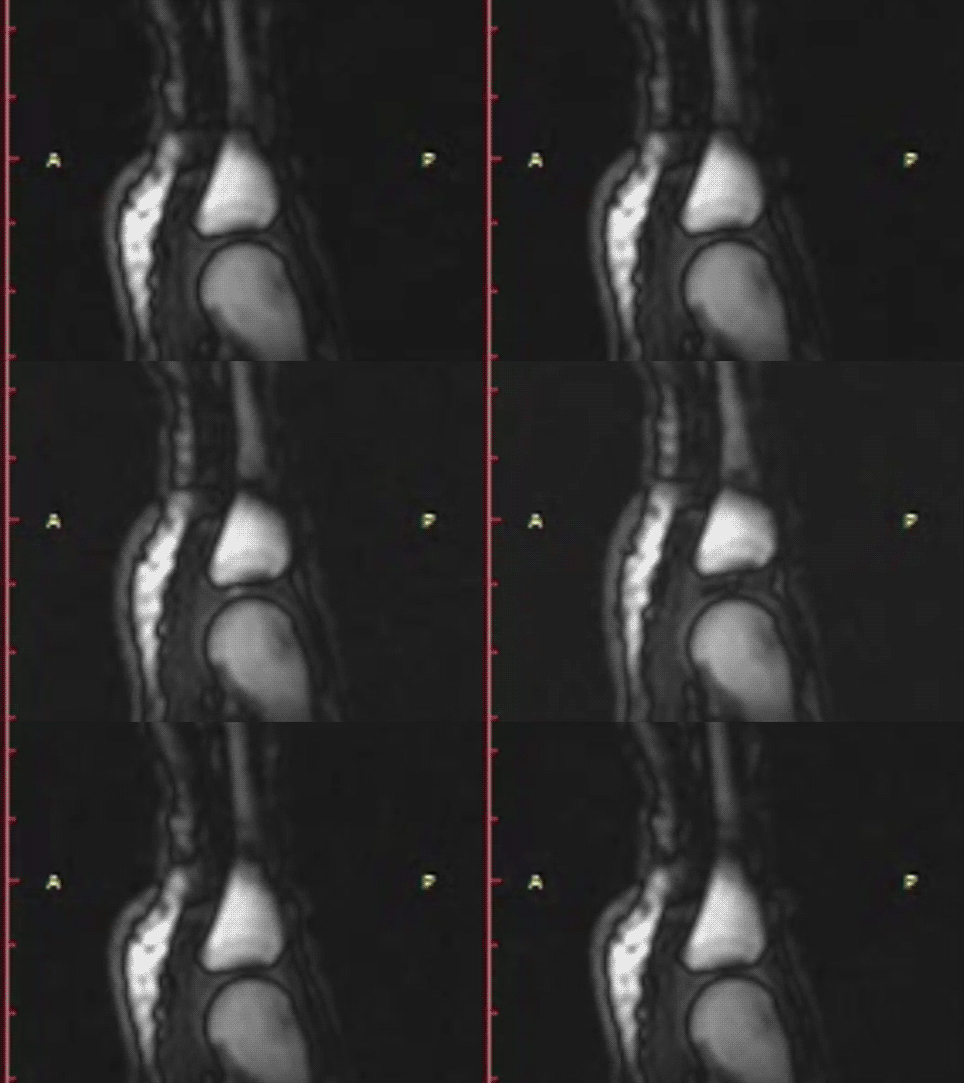
Cracking sounds emitted from human synovial joints have been attributed historically to the sudden collapse of a cavitation bubble formed as articular surfaces are separated. Unfortunately, bubble collapse as the source of joint cracking is inconsistent with many physical phenomena that define the joint cracking phenomenon. Here we present direct evidence from real-time magnetic resonance imaging that the mechanism of joint cracking is related to cavity formation rather than bubble collapse. In this study, ten metacarpophalangeal joints were studied by inserting the finger of interest into a flexible tube tightened around a length of cable used to provide long-axis traction. Before and after traction, static 3D T1-weighted magnetic resonance images were acquired. During traction, rapid cine magnetic resonance images were obtained from the joint midline at a rate of 3.2 frames per second until the cracking event occurred. As traction forces increased, real-time cine magnetic resonance imaging demonstrated rapid cavity inception at the time of joint separation and sound production after which the resulting cavity remained visible. Our results offer direct experimental evidence that joint cracking is associated with cavity inception rather than collapse of a pre-existing bubble. These observations are consistent with tribonucleation, a known process where opposing surfaces resist separation until a critical point where they then separate rapidly creating sustained gas cavities. Observed previously in vitro, this is the first in-vivo macroscopic demonstration of tribonucleation and as such, provides a new theoretical framework to investigate health outcomes associated with joint cracking.

Enjoy this live video demonstration


From the FULL TEXT Article:

Introduction

Background

Sounds emitted from human synovial joints vary in their origin. Joint sounds that occur repeatedly with ongoing joint motion arise typically when anatomic structures rub past one another. In contrast, “cracking” sounds require time to pass before they can be repeated despite ongoing joint motion. Although various hypotheses have been proposed over many decades regarding the origin of cracking sounds, none have been validated; the underlying mechanism of cracking sounds remains unknown.

History

(more…)

JAMA Recommends Chiropractic as First Means of Back Pain Treatment

By |April 15, 2015|Chiropractic Care, Low Back Pain|

JAMA Recommends Chiropractic as First Means of Back Pain Treatment

The Chiro.Org Blog


SOURCE:   FOX2now

John Pertzborn


JAMA`s recommendation comes on the heels of a recent study out of the medical journal Spine where sufferers of lower back pain all received standard medical care (SMC) and half of the participants additionally received chiropractic care.

The researchers found that in SMC plus chiropractic care patients, 73% reported that their pain was completely gone or much better after treatment compared to just 17% of the standard medical care group.