

Support Chiropractic Research!

BLOG

For Neck Pain, Chiropractic and Exercise Are Better Than Drugs

By |January 13, 2012|Chiropractic Care, Neck Pain|

For Neck Pain, Chiropractic and Exercise Are Better Than Drugs

The Chiro.Org Blog


SOURCE:   The New York Times ~ 1-03-12

By ANAHAD O’CONNOR


Seeing a chiropractor or engaging in light exercise relieves neck pain more effectively than relying on pain medication, new research shows.

The new study is one of the few head-to-head comparisons of various treatments for neck pain, a problem that affects three quarters of Americans at some point in their lives but has no proven, first-line treatment. While many people seek out spinal manipulation by chiropractors, the evidence supporting its usefulness has been limited at best.

But the new research, published in The Annals of Internal Medicine, found that chiropractic care or simple exercises done at home were better at reducing pain than taking medications like aspirin, ibuprofen or narcotics.

“These changes were diminished over time, but they were still present,” said Dr. Gert Bronfort, an author of the study and research professor at Northwestern Health Sciences University in Minnesota. “Even a year later, there were differences between the spinal manipulation and medication groups.”

Moderate and acute neck pain is one of the most frequent reasons for trips to primary care doctors, prompting millions of visits every year. For patients, it can be a difficult problem to navigate. In some cases the pain and stiffness crop up without explanation, and treatment options are varied. Physical therapy, pain medication and spinal manipulation are popular options, but Dr. Bronfort was inspired to carry out an analysis because so little research exists. (more…)
Stabilizing The Pelvis, Using the Modified Kemps and Straight Leg Raise Tests And Post-isometric Relaxation (PIR)

By |January 7, 2012|Modified Kemp's test, Orthopedic Tests, Pelvic Stability, Post-isometric Relaxation, Straight Leg Raise|

Stabilizing The Pelvis, Using the Modified Kemps and Straight Leg Raise Tests And Post-isometric Relaxation (PIR)

The Chiro.Org Blog


SOURCE:   Chiro.Org’s Low Back Pain Page


Dr. Leonard Faye reminds us in Chapter 6 of Schafer’s text “Motion Palpation” that:

“In all low-back pain cases, it is essential to test for
hamstring, quadriceps, and psoas length.”

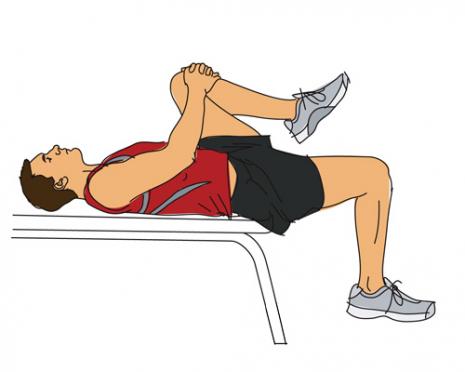
The picture on the left displays the positioning for the Modified Thomas Test. This test is is a very effective way to assess the length of 2 different muscles.

When the patient holds their knee to their chest, the following 2 things should become immediately apparent:

  1. If the psoas is of normal length, then the dependent thigh should be free to hang down 45° below the plane of the table. In this picture, the patient’s right psoas is significantly shortened.
  2. If the quadriceps are of normal length, the angle of the knee (between thigh and leg) should approximate 90°

If the psoas is shortened, it pulls the thigh into (some degree of) flexion, so the thigh cannot fully extend. This shortens your gait. Recalling that the origin of the psoas includes the lower thoracic vertebra, the lumbar segments I-IV, and the neighboring intervertebral discs, you can see why shortness would destabilize the lumbar and pelvic joints. Also… if the psoas is in contraction, the gluts may become inhibited by reciprocal inhibition.

If the quadriceps are shortened, it draws the leg into extension. Because portions of the quads originate on the pelvis, a shortened quads also distorts normal pelvic motion. (more…)

Nutrition: 4 Vitamins That Strengthen Older Brains

By |January 6, 2012|Nutrition|

Source NY Times

Higher blood levels of omega-3 fatty acids, vitamin B, vitamin C, vitamin D and vitamin E are associated with better mental functioning in the elderly, a new study has found.

Researchers measured blood levels of these nutrients in 104 men and women, whose average age was 87. The scientists also performed brain scans to determine brain volume and administered six commonly used tests of mental functioning. The study is in the Jan. 24 issue of Neurology.

After controlling for age, sex, blood pressure, body mass index and other factors, the researchers found that people with the highest blood levels of the four vitamins scored higher on the cognitive tests and had larger brain volume than those with the lowest levels.

Omega-3 levels were linked to better cognitive functioning and to healthier blood vessels in the brain, but not to higher brain volume, which suggests that these beneficial fats may improve cognition by a different means.

Higher blood levels of trans fats, on the other hand, were significantly associated with impaired mental ability and smaller brain volume.

The lead author, Gene L. Bowman, a researcher in neurology at Oregon Health and Science University, said that the study could not determine whether taking supplements of these nutrients would decrease the risk for dementia. But he added: “What’s the harm in eating healthier? Fish, fruits, vegetables all have these nutrients, and staying away from trans fats is one key thing you can do.”

Doctors Going Broke

By |January 6, 2012|Health Care|

Source CNN

NEW YORK (CNNMoney) — Doctors in America are harboring an embarrassing secret: Many of them are going broke.

This quiet reality, which is spreading nationwide, is claiming a wide range of casualties, including family physicians, cardiologists and oncologists.

Industry watchers say the trend is worrisome. Half of all doctors in the nation operate a private practice. So if a cash crunch forces the death of an independent practice, it robs a community of a vital health care resource.

“A lot of independent practices are starting to see serious financial issues,” said Marc Lion, CEO of Lion & Company CPAs, LLC, which advises independent doctor practices about their finances.

Doctors list shrinking insurance reimbursements, changing regulations, rising business and drug costs among the factors preventing them from keeping their practices afloat. But some experts counter that doctors’ lack of business acumen is also to blame.

Loans to make payroll: Dr. William Pentz, 47, a cardiologist with a Philadelphia private practice, and his partners had to tap into their personal assets to make payroll for employees last year. “And we still barely made payroll last paycheck,” he said. “Many of us are also skimping on our own pay.”

Pentz said recent steep 35% to 40% cuts in Medicare reimbursements for key cardiovascular services, such as stress tests and echocardiograms, have taken a substantial toll on revenue. “Our total revenue was down about 9% last year compared to 2010,” he said. (more…)

Brain Impact: Concussions, Chiropractic and New Laws

By |January 3, 2012|Concussion, Education, Traumatic Brain Injury|

Brain Impact: Concussions, Chiropractic and New Laws

The Chiro.Org Blog


SOURCE: Dynamic Chiropractic

By Robert “Skip” George, DC, CCSP, CSCS


Concussions are (finally) getting the attention of the athletic world, state governments and health care providers of all disciplines.

On Oct. 23, 2011, San Diego Chargers offensive guard Kris Dielman suffered a concussion during a football game against the New York Jets with 12:31 left to play.

He landed hard on the ground after a wicked collision with a Jets linebacker, then got up, wobbled and went back to playing the rest of the game, taking several more hits to the head. Neither the Chargers training staff nor the NFL referees recognized how serious his head injury was as he “waved off” his sideline training staff to return to the huddle. On the flight home to San Diego after the game, Dielman suffered a “grand mal” seizure and will most likely not play for the rest of the season.

Magnitude of the Problem

Concussions are getting much-needed attention in the press, especially given the short- and long-term cognitive loss, early-onset dementia, physical disability and even death resulting from traumatic brain injury (TBI). Chronic traumatic encephalopathy is a chronic, degenerative neurologic disease linked to repetitive head trauma and is known as an invisible killer that can make a 35-year-old brain look more like 80 years old.

There are 250,000 concussions annually in football alone. The prevalence in high-school and college athletics is a major concern, especially considering how big, fast and strong high-school and college athletes have become, and how their play emulates the professionals. This “evolution” is exacting a terrible toll regarding TBI in not only football, but also soccer, hockey, wrestling, water polo and cheerleading.


Three Purdue University professors tracked 21 football players from Lafayette Jefferson High School in Indiana. For two years they kept a record of every hit in practice and during games. They found that half of the players had neurophysiologic changes from contact. They also discovered that the repetitive hits the players were receiving had a cumulative effect on the brain and resulted in brain wave changes that mimicked concussion, even when the contact did not result in a concussion!

Concussion Basics

What is a concussion? It can be defined as “a complex pathophysiological process affecting the brain, induced by traumatic biomechanical forces” or “an immediate and transient loss of neuronal function secondary to trauma.” Signs and symptoms include but are not limited to thinking deficits, lack of sustained attention; amnesia; confused mental status; dazed look / vacant stare; slurred or incoherent speech; vomiting; nausea; emotional liability; slow motor or verbal response; memory deficits; poor coordination; dizziness; headache; restlessness; nervous weakness; exhaustion; and irritability. (more…)

A Systematic Review and Meta-analysis of Efficacy, Cost-effectiveness, and Safety of Selected Complementary and Alternative Medicine for Neck and Low-back Pain

By |January 2, 2012|Low Back Pain, Neck Pain, Spinal Manipulation|

A Systematic Review and Meta-analysis of Efficacy, Cost-effectiveness, and Safety of Selected Complementary and Alternative Medicine for Neck and Low-back Pain

The Chiro.Org Blog


SOURCE:   Evid Based Complement Alternat Med [Epub 2011 Nov 24]


Andrea D. Furlan, Fatemeh Yazdi, Alexander Tsertsvadze, * Anita Gross, Maurits Van Tulder, Lina Santaguida, Joel Gagnier, Carlo Ammendolia, Trish Dryden, Steve Doucette, Becky Skidmore, Raymond Daniel, Thomas Ostermann, and Sophia Tsouros

Clinical Epidemiology Methods Centre,
Ottawa Hospital Research Institute,
University of Ottawa Evidence-Based Practice Center,
Box 208, Ottawa, ON, Canada K1H 8L6


Background: Back pain is a common problem and a major cause of disability and health care utilization.

Purpose: To evaluate the efficacy, harms, and costs of the most common CAM treatments (acupuncture, massage, spinal manipulation, and mobilization) for neck/low-back pain.

Data Sources: Records without language restriction from various databases up to February 2010.

Data Extraction: The efficacy outcomes of interest were pain intensity and disability.

Data Synthesis: Reports of 147 randomized trials and 5 non-randomized studies were included. CAM treatments were more effective in reducing pain and disability compared to no treatment, physical therapy (exercise and/or electrotherapy) or usual care immediately or at short-term follow-up. Trials that applied sham-acupuncture tended towards statistically non-significant results. In several studies, acupuncture caused bleeding on the site of application, and manipulation and massage caused pain episodes of mild and transient nature.

Conclusions: CAM treatments were significantly more efficacious than no treatment, placebo, physical therapy, or usual care in reducing pain immediately or at short-term after treatment. CAM therapies did not significantly reduce disability compared to sham. None of the CAM treatments was shown systematically as superior to one another. More efforts are needed to improve the conduct and reporting of studies of CAM treatments.


Introduction:

Back pain is a general term that includes neck, thoracic, and lower-back spinal pain. In the majority of cases, the aetiology of back pain is unknown and therefore is considered as “nonspecific back pain”. Back pain is considered “specific” if its aetiology is known (e.g., radiculopathy, discogenic disease). Although back pain is usually self-limited and resolves within a few weeks, approximately 10% of the subjects develop chronic pain, which imposes large burden to the health-care system, absence from work, and lost productivity [1]. In a recent study, the direct costs of back pain related to physician services, medical devices, medications, hospital services, and diagnostic tests were estimated to be US$ 91 billion or US$ 46 per capita [2]. Indirect costs related to employment and household activities were estimated to be between US$ 7 billion and US$ 20 billion, or between US$25 and US$ 71 per capita, respectively [3–5]. One study published in 2007 showed that the 3-month prevalence of back and/or neck pain in USA was 31% (low-back pain: 34 million, neck pain: nine million, both back and neck pain: 19 million) [6]. (more…)