

Support Chiropractic Research!

Frank M. Painter

About Frank M. Painter

I was introduced to Chiro.Org in early 1996, where my friend Joe Garolis helped me learn HTML, the "mark-up language" for websites. We have been fortunate that journals like JMPT have given us permission to reproduce some early important articles in Full-Text format. Maintaining the Org website has been, and remains, my favorite hobby.

Recent Report Highlights Growing Dangers of Anti-Inflammatory Medications

By |January 30, 2012|Iatrogenic Injury, NSAIDs|

Recent Report Highlights Growing Dangers of Anti-Inflammatory Medications

The Chiro.Org Blog


SOURCE:   Dynamic Chiropractic ~ January 29, 2012

By James P. Meschino, DC, MS


In the Sept. 27, 2011 posting of the Biomedical Central Journal: Family Practice, R.J. Adams and colleagues commented on concerns raised by the common prescribing of nonsteroidal anti-inflammatory medications, particularly with respect to their important and sometimes fatal adverse side effects.

They state, “Non-steroidal anti-inflammation drugs (NSAIDs) are one of the most common causes of reported serious adverse reactions to drugs, with those involving the upper gastrointestinal tract (GIT), the cardiovascular system and the kidneys being the most common. Much of the focus on NSAID adverse effects has been on GIT consequences, with good reason. A U.S. study found the rate of deaths from NSAID-related GIT adverse effects is higher than that found from cervical cancer, asthma or malignant melanoma.” [1] They also point out that frequent use of NSAIDs increases risk for high blood pressure, chronic heart failure, as well as serious cardiovascular events (with certain NSAIDs).

Studies show that the risk of suffering these adverse side effects is increasing among the elderly and those with co-morbidities. The researchers cite recent evidence suggesting that the burden of illness resulting from NSAID-related chronic heart failure may exceed that resulting from GIT damage. [1]

Adams, et al., also cite evidence from a recent Danish population study, which suggests increased cardiovascular mortality among people without a prior history of heart disease, but who frequently use NSAIDs. This seems to be particularly true for diclofenac and ibuprofen. However, the baseline cardiovascular risk of people in this study was not reported. The researchers also note that NSAIDs promote the rapid deterioration of renal function. As such, national medical guidelines recommend avoidance of nephrotoxic drugs, including NSAIDs, in people with chronic kidney disease. [1]

Acetaminophen

It’s not only NSAID medications, such as drugs containing aspirin, ibuprofen, indomethacin, diclofenac, COX-2 inhibitors, that raise concerns regarding frequent and significant side effects, but also for acetaminophen-containing medications. The National Kidney & Urologic Diseases Information Clearinghouse (a service of the National Institute of Diabetes and Digestive and Kidney Diseases, National Institutes of Health) posted the following precautionary notes about acetaminophen on its Web site: (more…)

Cervical Spine Trauma

By |January 23, 2012|Chiropractic Care, Education|

Cervical Spine Trauma

The Chiro.Org Blog


We would all like to thank Dr. Richard C. Schafer, DC, PhD, FICC for his lifetime commitment to the profession. In the future we will continue to add materials from RC’s copyrighted books for your use.

This is Chapter 4 from RC’s best-selling book:

“Chiropractic Posttraumatic Rehabilitation”

These materials are provided as a service to our profession. There is no charge for individuals to copy and file these materials. However, they cannot be sold or used in any group or commercial venture without written permission from ACAPress.


CHAPTER 4:   CERVICAL SPINE TRAUMA

The cervical spine provides musculoskeletal stability and supports for the cranium, and a flexible and protective column for movement, balance adaptation, and housing of the spinal cord and vertebral artery. It also allows for directional orientation of the eyes and ears. Nowhere in the spine is the relationship between the osseous structures and the surrounding neurologic and vascular beds as intimate or subject to disturbance as it is in the cervical region.

BACKGROUND

Whether induced by trauma or not, cervical subluxation syndromes may be reflected in total body habitus. IVF insults and the effects of articular fixations can manifest throughout the motor, sensory, and autonomic nervous systems. Many peripheral nerve symptoms in the shoulder, arm, and hand will find their origin in the cervical spine, as may numerous brainstem disorders.


COMMON INJURIES AND DISORDERS OF THE CERVICAL SPINE


Cervical spine injuries can be classified as

(1) mild (eg, contusions, strains);

(2) moderate (eg, subluxations, sprains, occult fractures, nerve contusions, neurapraxias);

(3) severe (eg, axonotmesis, dislocation, stable fracture without neurologic deficit); and

(4) dangerous (eg, unstable fracture-dislocation, spinal cord or nerve root injury).

Spasm of the sternocleidomastoideus and trapezius can be due to strain or irritation of the sensory fibers of the spinal accessory nerve as they exit with the C2—C4 spinal nerves. The C1 and C2 nerves are especially vulnerable because they do not have the protection of an IVF. Radicular symptoms are rarely evident unless an IVD protrusion or herniation is present.

PREVALENCE

Because of its great mobility and relatively small structures, the cervical spine is the most frequent site of severe spinal nerve injury and subluxations. A large variety of cervical contusions, Grade 1—3 strains and sprains, subluxations, disc syndromes, dislocations, and fractures will be seen as the result of trauma.

The most vulnerable segments to injury are the axis and C5—C6 according to accident statistics. Surprisingly, the atlas is the least involved of all cervical vertebrae. In terms of segmental structure, the vertebral arch (50%), vertebral body (30%), and IVD (30%) are most commonly involved in severe cervical trauma. While the anterior ligaments are only involved in 2% of injuries, the posterior ligaments are involved in 16% of injuries.

EMERGENCY CARE

In the emergency-care situation, the patient with spinal cord injury must be treated as if the spinal column were fractured, even when there is no external evidence. Immediate and obvious symptom of spinal cord injury parallel those of fractures of the spinal column. The establishment of an adequate airway takes priority over all other concerns except for spurting hemorrhage. (more…)

DCs as Leaders in Health and Wellness: Part I

By |January 21, 2012|General Health, Wellness|

DCs as Leaders in Health and Wellness: Part I: Utilizing the Practice-Based Research Network to Show Evidence of Chiropractic’s Efficacy

The Chiro.Org Blog


SOURCE:  JACA Online

By Jay S. Greenstein, DC


Don’t just sit idly by and wait for your colleague down the street to sign up for ICON. We need him or her, but we need you too. Sign up today, and be part of the clinician-researcher army to show the world how important and special we are. It will help our profession, it will help your practice and most important it will help the millions of patients who don’t yet know how much we can help them.

As national health care reform takes hold, health care provider groups are staking claim to their slice of the health care pie. In fact, even in our own profession, there is an ongoing debate as to the role doctors of chiropractic will play. Should we be primary care physicians in the medical home (see www.foundation4cp.com/files/cp-medicalhome.Pdf) and/or accountable care organizations (ACO)? Should we alter our scope of practice to include prescription rights? Should we focus primarily on the spine?

While the debate rages on the aforementioned questions, I personally believe that the profession can rally around an even more important concept: Chiropractic must be the leading profession in health and wellness. We can be the cultural authority on this topic regardless of the answers to the questions above. In fact, most of us already perceive ourselves as health and wellness providers. But what does the evidence suggest? The evidence for Ds improving the overall health of our patients is paltry compared with the evidence supporting chiropractic for low-back pain. When was the last time you saw an article in a peer-reviewed journal that said, “Doctor of chiropractic services improve overall health metrics in patients compared to medical doctors”?

Anecdotally, we see this in our practices every day. Sharing stories with colleagues about how we helped our patients not only heal from their back pain but also become truly healthier is a daily occurrence. We must now turn those stories into evidence. Our profession needs evidence based on the rest of the world’s standards of what constitutes high quality research. That’s where the practice-based research network (PBRN) comes in.

Practice-Based Research Network

The PBRN, according to the U.S. Department of Health and Human Services Agency for Healthcare Research and Quality (AHRQ), is “a group of ambulatory practices devoted principally to the primary care of patients, and affiliated in their mission to investigate questions related to community-based practice and to improve the quality of primary care.”

Fortunately, the chiropractic profession has Cheryl Hawk, DC, PhD, a highly- regarded researcher at Logan College of Chiropractic, who, along with researchers at Parker University and Texas Chiropractic College, has built a new PBRN for chiropractic. This PBRN is named ICON, the Integrated Chiropractic Outcomes Network. There is a great need for this initiative, as well as a great need for every DC in the country to participate in this practice-based research initiative. I recently had the opportunity to sit down with Dr. Hawk to ask her about ICON. (more…)

ICA Files Suit in New Mexico Court of Appeals Seeking A Stay on Illegal State Chiropractic Board Actions

By |January 19, 2012|Announcement, Expanded Practice, Legislation|

ICA Files Suit in New Mexico Court of Appeals Seeking A Stay on Illegal State Chiropractic Board Actions

The Chiro.Org Blog


Acting on behalf of concerned members in New Mexico and out of concern for the integrity and credibility of the chiropractic profession at large, on December 21, 2011 the International Chiropractors Association (ICA) filed an extensive memorandum in support of a motion to stay what is being held to be illegal actions on the part of that state’s Board of Chiropractic Examiners. In its memorandum of explanation, ICA’s attorneys argued that it was important for the court to carefully consider the urgent issues of the letter of the law and the protection of both the public and chiropractic practitioners and prevent the “New Mexico Board of Chiropractic Examiners from implementing its new rule establishing an advanced practice formulary to include dangerous drugs and drugs to be administered by injection…and implementing its new rules establishing a certain course of training to certify advanced practice chiropractic physicians to administer and prescribe dangerous drugs and drugs to be administered by injection” because such actions were outside their authority under the law.

On August 30, 2011, at an official rulemaking hearing and meeting, the New Mexico Chiropractic Board adopted new rules to greatly expand the chiropractic formulary to include certain dangerous drugs and drugs to be administered by injection that had not been approved by either the New Mexico Medical or Pharmacy Boards as specifically required by state law. At that same hearing, lawyers representing the State of New Mexico were very clear in their advice that the Board was acting outside their authority and should not proceed. The Chiropractic Board ignored those admonitions and acted to adopt a new formulary anyway.

ICA representatives were present at both the August and December Board meetings and, in concert with New Mexico DCs, urged the Board to act only within the rules established by statute but to no avail. At their meeting of December 13, 2011, the New Mexico Chiropractic Board denied all requests to stay the implementation of the new rules pending appeal. ICA received official documentation of the New Mexico Chiropractic Board’s official denial of a request to stay the controversial rules on January 5, 2012. Having exhausted all administrative remedies, ICA is seeking the protection of the courts in the face of the Board’s questionable actions. (more…)

For Neck Pain, Chiropractic and Exercise Are Better Than Drugs

By |January 13, 2012|Chiropractic Care, Neck Pain|

For Neck Pain, Chiropractic and Exercise Are Better Than Drugs

The Chiro.Org Blog


SOURCE:   The New York Times ~ 1-03-12

By ANAHAD O’CONNOR


Seeing a chiropractor or engaging in light exercise relieves neck pain more effectively than relying on pain medication, new research shows.

The new study is one of the few head-to-head comparisons of various treatments for neck pain, a problem that affects three quarters of Americans at some point in their lives but has no proven, first-line treatment. While many people seek out spinal manipulation by chiropractors, the evidence supporting its usefulness has been limited at best.

But the new research, published in The Annals of Internal Medicine, found that chiropractic care or simple exercises done at home were better at reducing pain than taking medications like aspirin, ibuprofen or narcotics.

“These changes were diminished over time, but they were still present,” said Dr. Gert Bronfort, an author of the study and research professor at Northwestern Health Sciences University in Minnesota. “Even a year later, there were differences between the spinal manipulation and medication groups.”

Moderate and acute neck pain is one of the most frequent reasons for trips to primary care doctors, prompting millions of visits every year. For patients, it can be a difficult problem to navigate. In some cases the pain and stiffness crop up without explanation, and treatment options are varied. Physical therapy, pain medication and spinal manipulation are popular options, but Dr. Bronfort was inspired to carry out an analysis because so little research exists. (more…)

Stabilizing The Pelvis, Using the Modified Kemps and Straight Leg Raise Tests And Post-isometric Relaxation (PIR)

By |January 7, 2012|Modified Kemp's test, Orthopedic Tests, Pelvic Stability, Post-isometric Relaxation, Straight Leg Raise|

Stabilizing The Pelvis, Using the Modified Kemps and Straight Leg Raise Tests And Post-isometric Relaxation (PIR)

The Chiro.Org Blog


SOURCE:   Chiro.Org’s Low Back Pain Page


Dr. Leonard Faye reminds us in Chapter 6 of Schafer’s text “Motion Palpation” that:

“In all low-back pain cases, it is essential to test for
hamstring, quadriceps, and psoas length.”

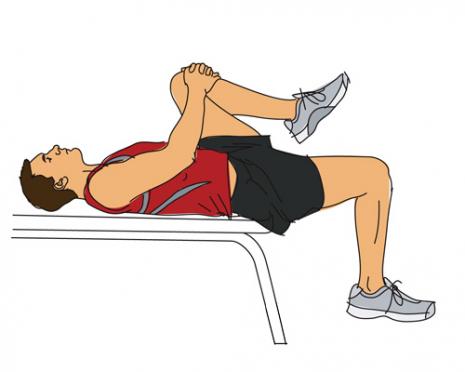
The picture on the left displays the positioning for the Modified Thomas Test. This test is is a very effective way to assess the length of 2 different muscles.

When the patient holds their knee to their chest, the following 2 things should become immediately apparent:

  1. If the psoas is of normal length, then the dependent thigh should be free to hang down 45° below the plane of the table. In this picture, the patient’s right psoas is significantly shortened.
  2. If the quadriceps are of normal length, the angle of the knee (between thigh and leg) should approximate 90°

If the psoas is shortened, it pulls the thigh into (some degree of) flexion, so the thigh cannot fully extend. This shortens your gait. Recalling that the origin of the psoas includes the lower thoracic vertebra, the lumbar segments I-IV, and the neighboring intervertebral discs, you can see why shortness would destabilize the lumbar and pelvic joints. Also… if the psoas is in contraction, the gluts may become inhibited by reciprocal inhibition.

If the quadriceps are shortened, it draws the leg into extension. Because portions of the quads originate on the pelvis, a shortened quads also distorts normal pelvic motion. (more…)