Support Chiropractic Research!

Frank M. Painter

About Frank M. Painter

I was introduced to Chiro.Org in early 1996, where my friend Joe Garolis helped me learn HTML, the "mark-up language" for websites. We have been fortunate that journals like JMPT have given us permission to reproduce some early important articles in Full-Text format. Maintaining the Org website has been, and remains, my favorite hobby.

MEDICARE INFO: Cross-Referencing Regions of Complaint, PART Findings, Diagnoses and CPT Codes

By |June 18, 2013|Documentation, ICD-10 Coding, Medicare|

MEDICARE INFO: Cross-Referencing Regions of Complaint, PART Findings, Diagnoses and CPT Codes

The Chiro.Org Blog


SOURCE:   Dynamic Chiropractic ~ June 15, 2013

By K. Jeffrey Miller, DC, DABCO


In 2012 the Centers for Medicare and Medicaid Services and CMS-contracted reviewers performed chiropractic Medicare reviews nationwide. The results of their efforts were not good news for the chiropractic profession.

The reviews pointed to poor record-keeping and billing practices throughout the profession. Claims were also made of inappropriate billing of maintenance care resulting in significant overpayments for chiropractic services. [1] Unfortunately, these findings were consistent with previous CMS chiropractic reviews. [2]

Of the current review findings, the one that is most disappointing is our consistency from one CMS review to the next. It is difficult to respond to our many Medicare problems all at once. It can be overwhelming. However, while we cannot fix everything at once, we can fix something.

There are a specific set of closely related problems that can and should be addressed together. In actuality, the problems are so intertwined that they are really a single concern: matching the number of symptomatic spinal / pelvic regions; the number of spinal /pelvic regions with PART and/or X-ray findings of subluxation; the number of diagnoses, the number of regions adjusted; and the CPT code used to bill for the adjustment.

Volumes have already been written about this concern. Here, I offer a set of questions to help guide doctors in documenting the number of patient complaints, subluxations, diagnoses, regions adjusted and the appropriate billing codes. This series of questions is accompanied by comments and tables to clarify the importance of each question.

Questions to Ask Yourself After Examining a Medicare Patient

  1. How many regions of the spine / pelvis did the patient list as painful or symptomatic? Medicare is not purely subluxation based, despite the original and lasting rule that a subluxation must be documented in any region adjusted. The diagnostic criteria also require a symptom code for each region of subluxation. With this in mind, Medicare assumes the patient to have a complaint in each region treated and that the patient reported these complaints during their history. This is a common expectation for many other carriers as well. Carriers do not feel treatment of a region that is asymptomatic is necessary. “Asymptomatic” for Medicare and many other carriers translates to “no problem or no condition.”

There are more articles like this @ our:

Medicare Information Page

(more…)

Chiropractic Research: A Moral Issue

By |June 11, 2013|Chiropractic Research|

Chiropractic Research: A Moral Issue

The Chiro.Org Blog


SOURCE:   Dynamic Chiropractic ~ June 1, 2013


By Stephen M. Perle, DC, MS


This year I’ve had the opportunity to go to three great chiropractic research conferences; the Association of Chiropractic Colleges / Research Agenda Conference (ACC-RAC), the Fédération Internationale de Chiropratique du Sport (FICS) Congress and the World Federation of Chiropractic Congress. Seeing the wide range of both basic and clinical-science research made me proud to be a doctor of chiropractic.

In my time in the profession I’ve witnessed amazing progress in the state of chiropractic research. A little over 30 years ago I was a research assistant at Texas Chiropractic College. Our new research director at the time, Dr. Jay Simon, asked me to search for what research there was about chiropractic and manipulation. Hours in the library at TCC, Baylor Medical College and the Texas College of Osteopathic Medicine resulted in less original research than I saw and heard at these three conferences. I think the body of research is expanding in ways that will positively impact our management of patients.

This research is leading to a real Golden Age for our profession despite the battles we need to fight – and maybe because of them. I have worked with the American Chiropractic Association in helping reverse the decisions of a few insurance carriers that intended to discontinue coverage for certain conditions treated by chiropractic physicians. The reversal of those policy changes was based entirely on seeing the scientific evidence that demonstrated the safety and efficacy of our care.

We know so much more about the effects and clinical and cost-effectiveness of our interventions than I dreamed of while sitting in those libraries digging away to find any evidence. Yet despite being a research assistant in chiropractic college back then, I never really saw how research was going to benefit our patients, profession or me when I started my practice in 1983. (more…)

We Are Tough And Ornery

By |May 30, 2013|Announcement|

We Are Tough And Ornery

The Chiro.Org Blog


For the second month in a row we were knocked offline for 12 or more hours, first by a computer malfunction, and yesterday by an upline network blow-out.

We’ve been doing what we do for more than 18 years, and we have virtually no overhead costs, since everyone’s a volunteer doctor. So, if you ever see us missing, it’s only a technical problem, it’s NOT that we’ve given up the job.

We’re here to stay, and we expect you to stand your ground and stick with us. No other chiropractic information site comes close to what we do, and we’re here to stay. That’s because We Are Tough And Ornery, and we love what we do, and we know that you love it too!

Specific Potentialities of the Subluxation Complex

By |May 27, 2013|Cervical Spine, Diagnosis, Education, Subluxation|

Specific Potentialities of the Subluxation Complex

The Chiro.Org Blog


We would all like to thank Dr. Richard C. Schafer, DC, PhD, FICC for his lifetime commitment to the profession. In the future we will continue to add materials from RC’s copyrighted books for your use.

This is Chapter 7 from RC’s best-selling book:

“Basic Principles of Chiropractic Neuroscience”

These materials are provided as a service to our profession. There is no charge for individuals to copy and file these materials. However, they cannot be sold or used in any group or commercial venture without written permission from ACAPress.


Chapter 7: Specific Potentialities of the Subluxation Complex

This chapter describes the primary neurologic implications of subluxation syndromes, either as a primary factor or secondary to trauma or pathology, within the cervical spine, thoracic spine, lumbar spine, and pelvic articulations.


GENERAL CONSIDERATIONS


Studies reported by Drum, Hargrave-Wilson, Kunert, Burke, Gayral/Neuwirth, and others have shown that a subluxation complex, often leading to spondylosis, can effect a wide variety of disturbances that may appear to be disrelated on the surface. Most of the remote effects can be grouped under the general classifications of nerve root neuropathy, basilar venous congestion, cervical autonomic disturbances, CSF pressure and flow disturbances, axoplasmic flow blocks, irritation of the recurrent meningeal nerve, the Barre-Lieou syndrome, and/or the vertebral artery syndrome.

This chapter describes many causes for and effects of a spinal subluxation complex. In clinical practice, however, causes and effects are rarely found as isolated entities. Several factors will usually be involved and superimposed on each other.

Innervation of the Spinal Dura

It has long been known that the spinal dura mater has an intrinsic nerve supply. Spinal meningeal rami are derived from gray communicating rami and spinal nerves. The spinal nerves contribute sensory fibers to the meningeal rami. Several meningeal rami enter each IVF, and most are located anteriorly to the sensory ganglia within the IVF.

Bridge found that these intrinsic nerve fibers reach the anterior surface of the dura by three main courses. Here the nerves divide into ascending and usually longer descending filaments that run longitudinally and parallel on the dural surface, and a considerable amount of nerve overlaps from adjacent segments. Finer filaments penetrate the dural substance where they subdivide.

Kimmel reported that most of these fibers penetrate the dura near the midline, while others enter laterally near the exiting spinal nerve roots. At each segment level, two or three nerves enter the spinal dura mater and contain only small nerve fibers. In contrast, Edgar/Nundy could determine no definitive nerve endings, but the nerves could be traced to the posterior aspect of the spinal dura. These observations help to clarify the wide distribution of back pain that is often found following protrusion of a single IVD.

Cervical Dura Attachments

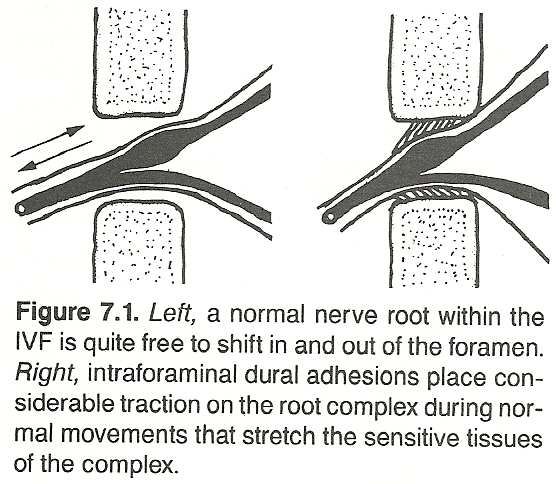
Sunderland states that the nerve sheaths in the cervical region are not firmly attached to their respective foramina. Only the C4 C6 cervical nerves have a strong attachment to the vertebral column, and this is to the gutter of the vertebral transverse process. He believes that these observations have relevance to any local lesion that may fix, deform, or otherwise affect the nerve and its nroots to the point of interfering with their function, and they also may be important to traction ijuries of nerve roots.

(more…)